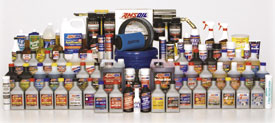
"Every time that I slide a feeler gauge between the rocker arms and valve tappets to check the intake/exhaust valve adjustments, I am amazed at the amount of AMSOIL that clings to the gauge - even after the engine has sat for 3 or 4 days without being run. It was a noticeable difference over the petroleum oil that would rapidly run back down to the crankcase. My findings have convinced me that there is no other oil good enough for my racing engine." Paul Anderson

"Royal Purple uses a different chemistry than most. They are one of only a handful of marketers using Moly in their oil. Moly is a solid, specifically banned by Cummins [Engine Company], due to excessive valve train wear.
Moly (Molybdenum Disulfide) is a processed mineral that is similar in appearance to graphite. Particles of the Moly can come out of suspension and agglomerate(form into one cluster). This can actually clog oil filters or oil lines and the rest normally settles in the bottom of the oil pan. This seems to be more likely when using extended drain intervals.
The only test we ran on Royal Purple involved their 20W50 Racing oil versus our AMSOIL Series 2000 Synthetic 20W50 Racing Oil (TRO). We ran two 4 ball wear tests with different parameters, a spectrographic baseline, FTIR scan and volatility tests.
Royal Purple showed a significantly high volatility rate with a 12.51% boil off rate. This compares to AMSOIL with a 4.47% volatility rating.
Wear scars were also smaller with the TRO. For example the TRO left a .41mm scar and the Royal Purple oil left a .66mm scar. There was also a surprising difference in the viscosity index. The RP has a VI of 129 versus 155 for the TRO. The higher the VI, the better the viscosity stays in place at high temperatures.
This information was provided by the AMSOIL Tech Department. They had an independent lab test Royal Purple against AMSOIL. The results are posted above. They have found Moly in Royal Purple. As stated above, this can have negative effects on your engine."